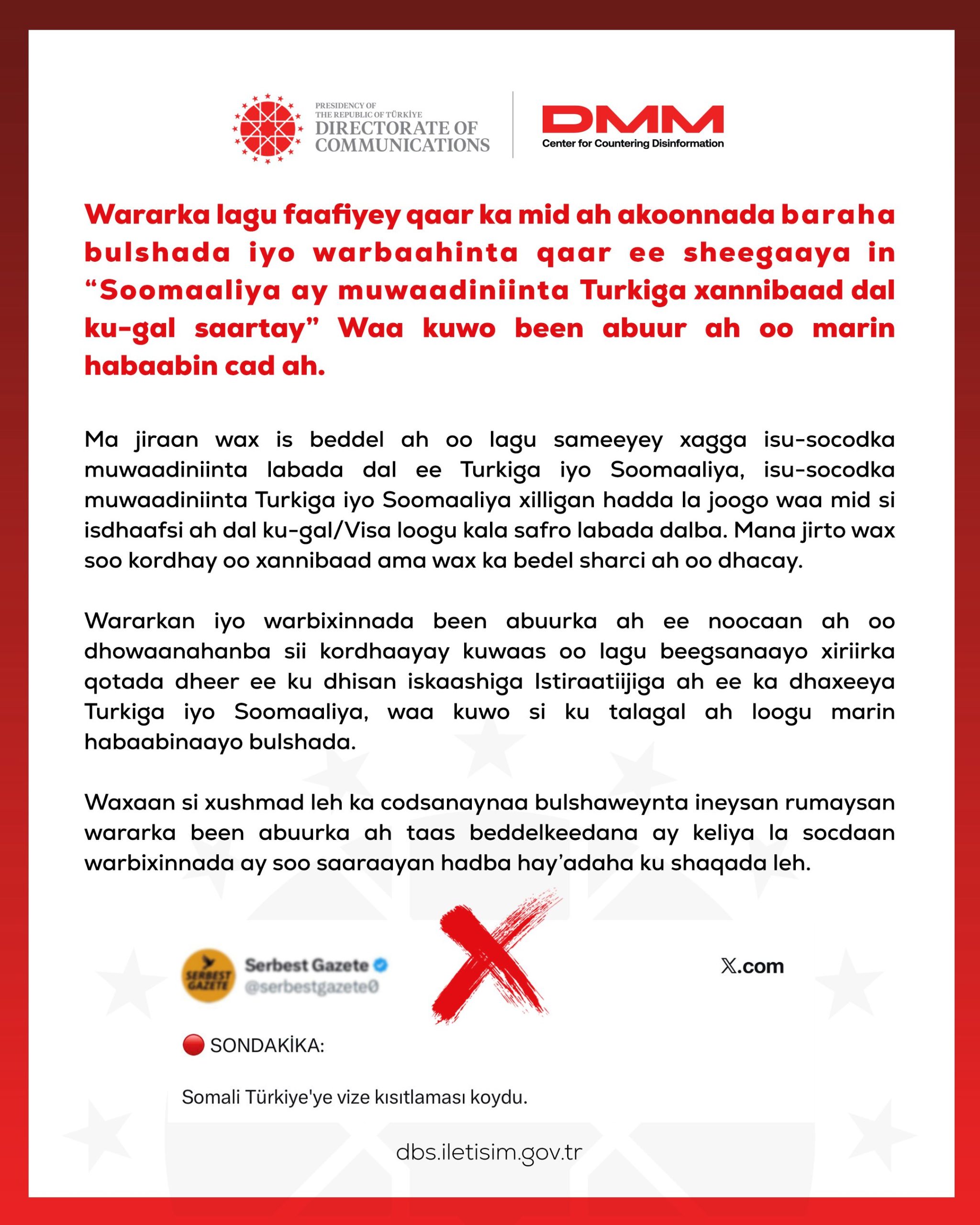
The rapid growth of social media in Somalia has made information easier to access and share. But it has also created greater opportunities for false information, fabricated reports, hate speech, incitement and other harmful content to spread quickly.
So, what do Somali law and Islamic law say about these practices?
The answer requires an important distinction. Not every inaccurate statement is automatically a crime. Somali law protects freedom of expression, while also containing provisions dealing with false information and certain forms of harmful speech. Islamic principles similarly place strong emphasis on truth, verification, protection of reputation and avoiding harm.
What is the difference between misinformation and disinformation?
Misinformation is false or inaccurate information shared without necessarily intending to deceive. A person may, for example, share an inaccurate report believing that it is true.
Disinformation is false or manipulated information deliberately created or distributed to deceive people or achieve a particular political, social, financial or other objective.
Hate speech generally refers to expression that attacks, promotes hatred against, or may incite discrimination, hostility or violence against people because of characteristics or group identity.
Harmful content is a broader category. It can include incitement to violence, dangerous rumours, defamatory allegations, extremist material, manipulated information and other content capable of causing identifiable harm.
These distinctions matter because intention, content, context and likely harm can affect how a case is treated legally.
What does the Somali Constitution say?
Somalia’s constitutional framework strongly protects freedom of expression.
Article 18 of the Provisional Constitution states that every person has the right to hold and express opinions and to receive and impart information and ideas. It specifically extends this protection to freedom of speech and the media, including electronic and web-based media.
This means journalists, citizens and media organisations have constitutional protection when reporting news, expressing opinions, conducting investigations and discussing matters of public interest.
However, freedom of expression should not be confused with an unrestricted right to deliberately fabricate harmful information, incite violence or engage in other conduct prohibited by law.
There is also a direct constitutional connection between Somalia’s legal system and Islam. Article 2 establishes Islam as the religion of the state and provides that no law may be enacted if it is inconsistent with the general principles of Shari’ah.
What does the Somali Penal Code say about false information?
One of the provisions frequently discussed in relation to false information is Article 328 of the Somali Penal Code, concerning the publication or circulation of false, exaggerated or tendentious news capable of disturbing public order.
In information submitted to the United Nations, the Somali government explained that Article 328 covers publication and circulation, including rumours communicated orally. According to that explanation, prosecutors must establish the relevant connection to disturbing public order; disagreement over facts, satire and hyperbole are not automatically covered.
Article 328 has also been used in cases involving journalists. For example, Somali media organisations have documented charges under Article 328 for the publication or circulation of false, exaggerated or tendentious news.
This distinction is important: an ordinary factual error should not automatically be treated in the same way as deliberately or culpably spreading false information in circumstances falling within a criminal prohibition.
What does Somalia’s Media Law say?
Somalia’s amended Media Law was signed into law in August 2020 after approval by both houses of the Federal Parliament. The government described the legislation as protecting press freedom and establishing rules governing journalism and media practice.
Article 4 of the Media Law has been reported as restricting several categories of content, including false news, incitement to violence or clan-based division, unfounded propaganda, and news containing hatred or extremism.
However, these provisions have also generated significant freedom-of-expression concerns.
Journalists’ organisations and international human-rights groups have argued that terms such as “false information,” “national interest,” “propaganda,” and some other content restrictions can be too broad or vague and therefore risk being applied against legitimate journalism.
This creates an important legal and journalistic principle: combating disinformation should not become a justification for suppressing legitimate criticism, investigative reporting or political disagreement.
What does Islamic law say about false information?
Islamic teachings place particular emphasis on verifying information before acting upon or spreading it.
One of the clearest principles appears in Surah Al-Hujurat, verse 6, which instructs believers to verify information received from an unreliable source so that people are not harmed through ignorance and regret follows afterward.
This principle—often discussed through the concept of tabayyun, or verification—has direct relevance to modern journalism and social media.
Before publishing a serious allegation, a journalist should therefore ask: Who is the source? What evidence supports the information? Has the other side been contacted? Can the allegation harm an innocent person if it is wrong?
These are not only professional fact-checking questions; they closely reflect the Islamic principle of verifying information before causing harm.
What about spreading rumours?
Islamic teachings also caution against repeating everything a person hears.
A well-known hadith recorded in the introduction to Sahih Muslim warns that it is sufficient for a person to fall into falsehood by repeating everything they hear. The principle is particularly relevant to today’s social-media environment, where unverified claims can reach thousands of people within minutes.
Receiving information, therefore, does not create an obligation to publish it.
A Facebook post, WhatsApp message, anonymous source or viral video should not be treated as established fact simply because many people have shared it.
What about insults, rumours and damage to reputation?
Islamic teaching also protects personal dignity and reputation.
Surah Al-Hujurat addresses suspicion, spying and backbiting. Islamic scholarship distinguishes ghibah, saying something true about someone behind their back that they would dislike, from false accusations or slander, which are more serious because the damaging allegation itself is untrue.
For journalists and social-media users, this means allegations affecting someone’s reputation require particular care.
Public-interest reporting and legitimate criticism are not the same thing as inventing allegations, deliberately humiliating someone or spreading an accusation without adequate evidence.
What about hate speech and incitement?
Both the legal and Islamic approaches place particular importance on speech that can produce real-world harm.
Somalia’s Media Law includes restrictions reported to cover incitement to violence, promotion of clan division, hatred and extremism.
This is especially significant in Somalia, where inflammatory information concerning clans, political disputes, armed conflict or terrorism can potentially contribute to violence.
But authorities and media institutions must still distinguish between hate or inciting speech and legitimate criticism.
Criticising a government, politician, institution, clan-based political system or religious interpretation is not automatically hate speech. Context, wording, target, intention and the risk of harm must be considered.
How do Somali law and Islamic principles come together?
There is substantial overlap in their underlying objectives.
Somali law protects expression but provides legal mechanisms addressing certain false and harmful communications. Islamic principles emphasise truthfulness, verification, protection of dignity, avoidance of unjust accusations and prevention of harm.
For journalists, fact-checkers and social-media users, these principles can be reduced to a practical rule:
Verify before publishing, distinguish fact from opinion, provide evidence for serious allegations, avoid deliberate deception, and consider whether publication could unjustly harm individuals or society.
Can journalists still criticise the government?
Yes.
The constitutional protection of freedom of expression covers opinions, information, media and online communication.
A journalist does not commit “misinformation” merely because a government official disagrees with a report.
Similarly, reporting allegations against officials, exposing corruption, questioning government policy or publishing critical analysis should not automatically be classified as harmful content.
The central journalistic questions are whether factual assertions have been responsibly verified, whether evidence exists, whether opinion is clearly distinguished from fact, and whether publication serves a legitimate public interest.
Why does this matter for Somalia?
Disinformation can have consequences far beyond social media.
A fabricated report about military movements could increase insecurity. A false allegation against a community could inflame clan tensions. Manipulated images could create panic. False information about elections could undermine public confidence, while extremist propaganda can encourage violence.
At the same time, overly broad attempts to combat “fake news” can threaten press freedom when legitimate journalism is wrongly treated as a criminal offence. International human-rights organisations have specifically raised this concern regarding provisions in Somalia’s Media Law.
The challenge is therefore to combat genuinely harmful disinformation while protecting legitimate journalism and freedom of expression.
Conclusion
Somali law and Islamic principles both provide important frameworks for addressing false and harmful information.
The Constitution protects freedom of expression and media freedom, while the Penal Code and Media Law contain provisions that may apply to certain false information, incitement, hate-related content and other harmful communications. Islamic teachings add a strong ethical requirement to verify information, tell the truth, protect people’s reputations and avoid spreading information that unjustly harms others.
For Somali journalists and social-media users, the principle is straightforward: freedom of expression carries responsibility, but combating misinformation must also respect the constitutional right to free and independent expression.